BMSLab Research Uses Battery Relaxation to Improve State and Health Estimation
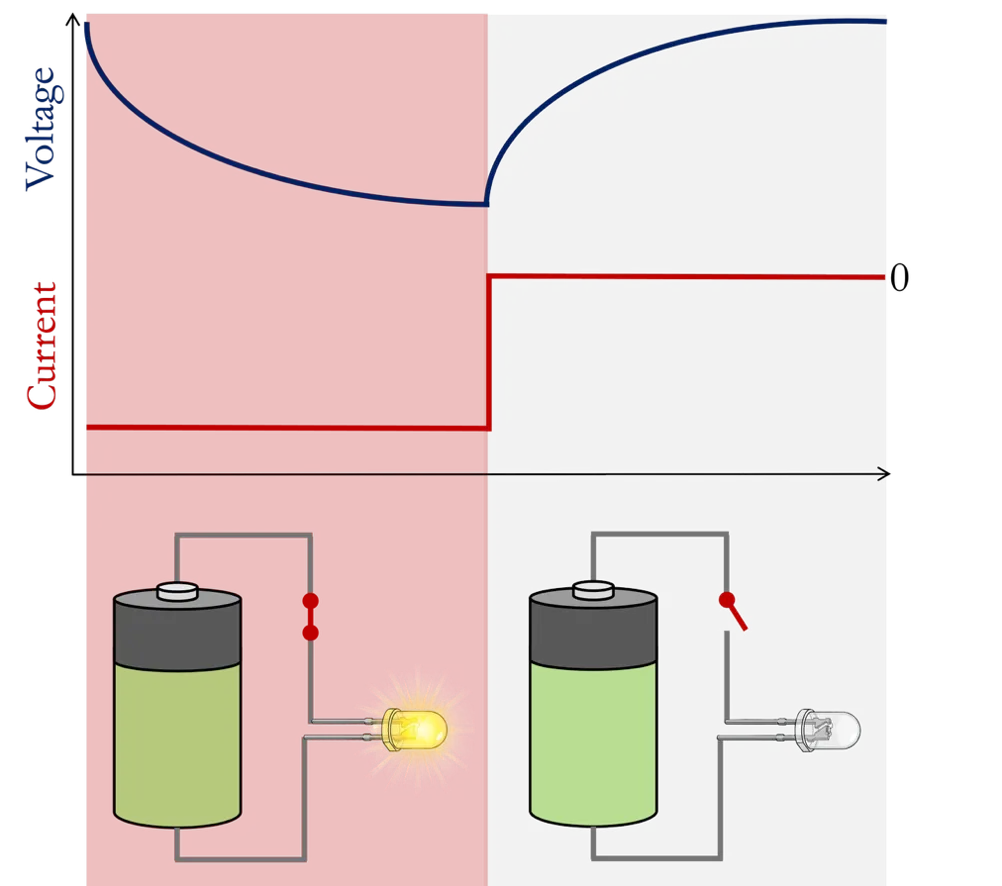
Battery relaxation may look like a simple voltage recovery process, but it contains valuable information
about what is happening inside the battery. The shape and speed of the relaxation response are related to
the battery's internal resistance, time constants, state of charge, and state of health. In other words, by
carefully studying how a battery relaxes after a current pulse, we can learn more about the battery's
condition.
However, extracting useful model parameters from relaxation data has remained challenging. Many existing
methods require long rest periods, pre-calibrated open-circuit voltage information, nonlinear optimization,
carefully chosen initial guesses, or very accurate high-frequency voltage and current measurements that may
require costly sensing and data-acquisition hardware. These requirements can make the methods difficult to
use in practical battery management systems, where the algorithm must be accurate, reliable, computationally
inexpensive, and able to work with realistic measurements.
BMSLab research led by PhD candidate Sooraj Sunil addresses this challenge through a new two-stage
least-squares method for estimating battery equivalent-circuit model parameters from pulse–relaxation
data.
The method works by separating the estimation problem into two simpler steps. First, the relaxation part of
the
voltage response is used to estimate the battery's relaxation time constants. Then, the full current–voltage
response is used to estimate the remaining model parameters, including the battery's open-circuit voltage and
resistance values.
"While reviewing the literature, I came across a recent approach that demonstrated very accurate estimation of battery relaxation parameters. However, the method required prior calibration of the battery's open-circuit voltage. I realized that tools recently developed at BMSLab could remove this requirement and make the method more practical for battery management applications."
— Sooraj Sunil
A key advantage of the proposed method is that it avoids iterative nonlinear optimization. Instead, the
estimation is formulated using linear least-squares steps, making the approach computationally efficient,
reliable, and less sensitive to numerical difficulties or poor initial guesses.
The research also provides theoretical and experimental validation of the method. The team analyzed the
best
achievable estimation accuracy under measurement noise and tested the approach using lithium-ion battery data.
The results showed accurate model-parameter estimation with strong voltage-fitting performance across typical
battery operating conditions.
This work is significant because accurate relaxation-parameter estimation improves battery modeling, SOC
estimation, SOH diagnostics, and battery power prediction. By making the estimation process simpler and more
reliable, the method provides a practical foundation for improved battery management in electric vehicles,
energy-storage systems, and portable electronics.
The work was published in IEEE Transactions on Instrumentation and Measurement as "Two-Stage Least Squares for
Equivalent-Circuit Model Parameter Estimation of Li-Ion Batteries Using Pulse-Relaxation Excitation."